“Fire in Borgo” by Raphael — Vatican Museum –Vatican City
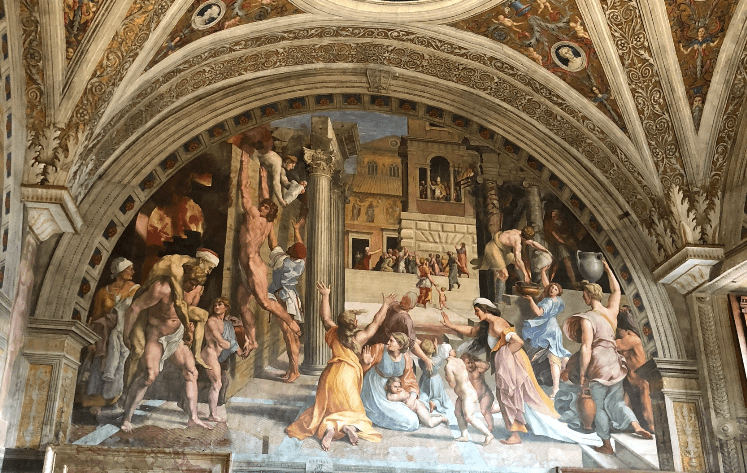
Raphael’s “Fire in Borgo” is a fresco in the Vatican Museum’s Raphael Room named “Stanza dell’incendio del Borgo.” The Vatican Museum is covered with various artworks and in a room full of enormous frescoes, this one in particular stood out. I was drawn to “Fire in Borgo” because of all the chaos, people are scrambling, but I couldn’t figure out why. Once I read the title and saw the flames in the upper left corner, I was able to breakdown the fresco and analyze the work more thoroughly.
When analyzing the painting, I split the painting into three sections; the left half, the top of the right and the bottom of the right half. On the left edge you can see the fire, this fire changed the way I interpreted the painting. The naked man who I though was trying to scale the wall became a survivor trying to escape the flames. The two men in the bottom left were no longer fighting, but instead, a young man was helping an older man escape the flames. Originally the top right was the last part of the work my eyes were drawn too, but after my research I now see it as the centerpiece. Here, Pope Leo IV can be seen extinguishing the great fire. In the bottom right, a strange conflict of chaos became women pleading to the Pope and praying.
Scholars criticize this fresco because it lacks proportion, narrative and structural coherence. Considering the differences between my initial impression and my educated understanding of the work these are fair criticism. I definitely think that more attention should be drawn to the Pope Leo IV. It is important to point out that this fresco came from Raphael’s workshop, but it is widely believed that it was actually painted by his assistant, Giulio Romano.
Reference
Reilly, Patricia, L. “Raphael’s Fire in the Borgo’ and the Italian Pictorial Vernacular.” The Art Bulletin. Vol. 92, No. 4, December 2010, pp 308-325.
“The Colosseum” by Renato Guttuso — Vatican Museum — Vatican City
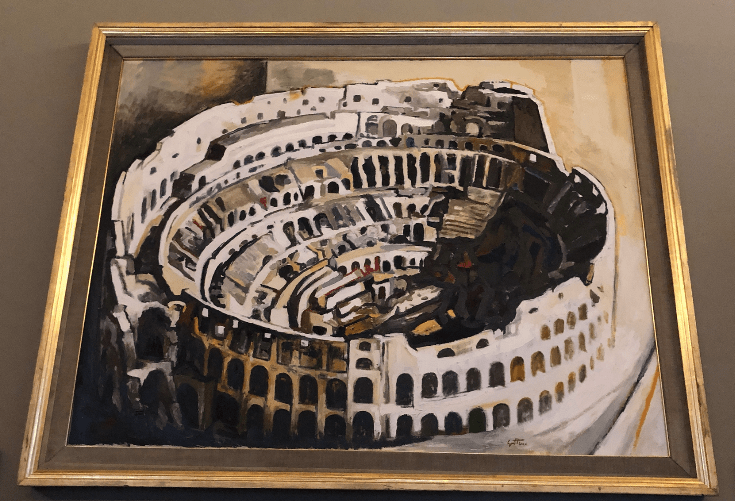
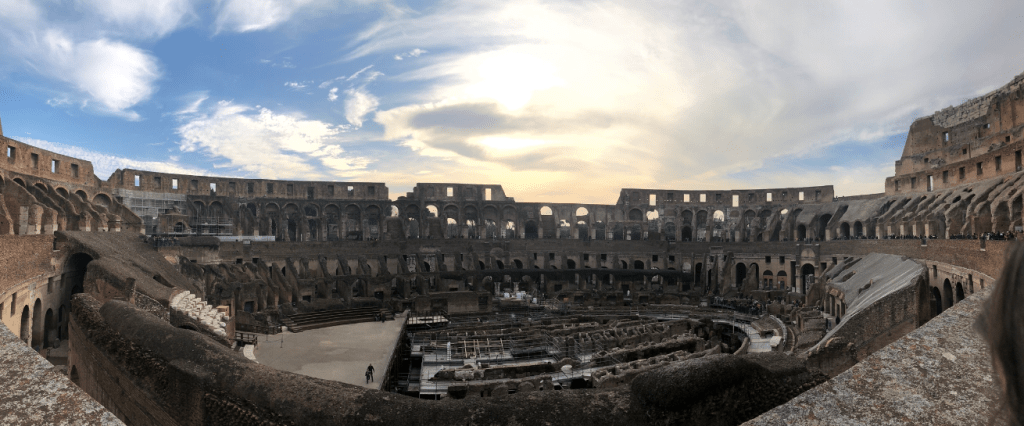
“The Colosseum” is a 1972 oil painting on canvas by Italian expressionist Renato Guttuso. This painting was gifted to the Vatican Museum by Guttuso and still hangs there today. I went to closely look at the painting because I had just been to the Colosseum the day prior. The painting’s version of the Colosseum resembled the version I had seen. The top level walls were crumbled along with the seats surrounding the center, the trap doors and cells underneath were exposed. Even though it was similar, the painting was not intended to perfectly recreate the structure. Guttuso used the colors black and red throughout the work. These reminded me of the stories I had heard of the Colosseum and its purpose. The red represented the blood of the gladiators and animals that participated in the “games.”
As I researched Guttuso and found he was an expressionist, I thought that was the meaning he was trying to portray, but I also developed an alternative theory. Guttuso was a known an active member of the communist party, which was often symbolized by the color red. Guttuso was born in Sicily, but spent a considerable amount of time living in Rome and lived there when he painted this (1972). The theory is that Guttuso took a part of his home city and put a personal twist on it. The Colosseum is a part of his home and the personal twist is the communist party represented through use of red.
Reference
Biography Renato Guttuso Website. https://www.guttuso.com/biografia/?lang=en
 Grand Tour — Winter 2020