“The Duke and Duchess of Urbino Federico da Montefeltro and Battista Sfotza” — Uffizi Gallery
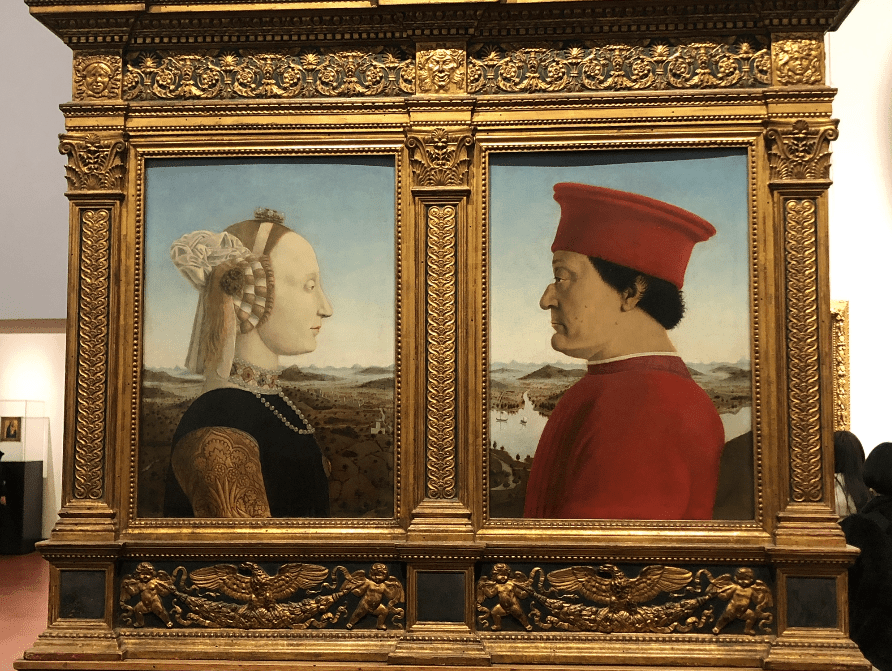
In the Uffizi gallery, I saw an early Italian renaissance painting entitled “The Duke and Duchess of Urbino Federico da Montefeltro and Battista Sforza” by Piero della Francesca. There was a painting on the backside as well, but I will focus on the front side’s portrait. The painting stood out to me because of the level of detail compared to the medieval paintings at the front of the gallery.
Renaissance paintings are known for their detail, but transitioning from a medieval painting directly to a renaissance painting really highlights the differences. On the lake behind the Duke you can see two boats, the detail is so great you can tell which way the wind is blowing by looking at their sails and even see their reflections in the water. I also was able to notice how you can see each individual sparkle on the Duchess’ necklace. This detail helped me realize the strides artists made during the renaissance period.
Their status can easily be interpreted by the title, but also from the Duchess’ jewelry and the fact that the Duke is wearing red clothing. However, my guide at the Uffizi explained to my group that the profile portrayal was supposed to show their status as well. She said that profiles became popular because important figures were portrayed in profile on coins. In addition, the Uffizi website informed me that the profile representation was allowed Piero della Francesca to avoid some of the Duke’s less-desirable characteristics. The Duke lost his right eye in battle and a profile portrait was a way to keep the painting accurate and aesthetically pleasing.
Reference
“The Duke and Duchess of Urbino Federico da Montefeltro and Battista Sforza.” Le Gallerie Delgi Uffizi. https://www.uffizi.it/en/artworks/the-duke-and-duchess-of-urbino-federico-da-montefeltro-and-battista-sforza
Michelangelo’s “David” — Accademia Gallery
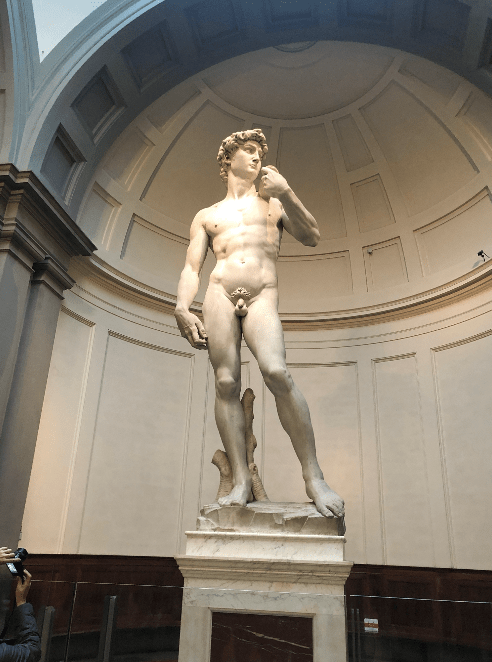
Michelangelo’s “David” is widely regarded as one of the greatest works of art known to man, Giorgio Vasari has even claimed “When all was finished, it cannot be denied that this work all carried off the palm from all other statues…” The size of the “David” shocked me, as I entered the room the statue towered over the surrounding people. The enormous sculpture is also incredibly detailed. The detail in the contours of the muscles, the curls in the hairs, and even the minute details such as forearm veins and kneecaps. After analyzing the detail and size of Michelangelo’s “David,” I engaged in a discussion with my peers over how long we thought this sculpture took Michelangelo. With assumptions of a 40 hour days, six days a week, the estimations ranged from a year and a half to over ten years. The Accademia’s website informed me that the “David” took Michelangelo two years. Two years is a long time, but still an impressive timeline for such a large, detailed statue.
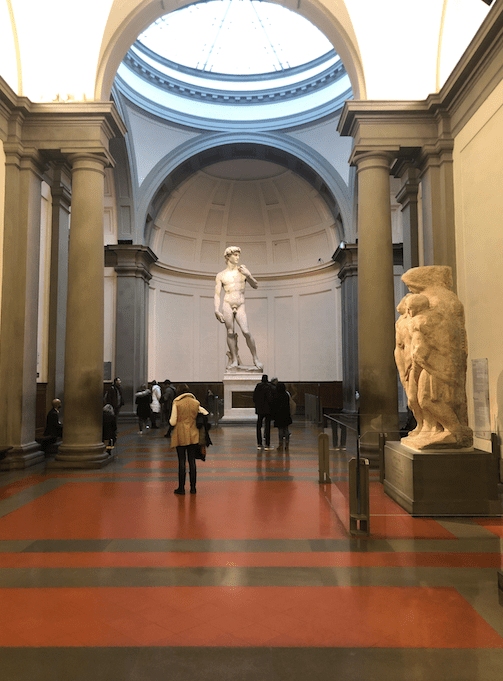
A layman would think that the hands and head may be too large, but my professor and other guides have informed me, the hands and head are that size because of perspective. The sculpture was supposed to be perched on a church, here, the head and hands would appear proportional to the body. “David” was made to be viewed from the perspective of a person on the ground looking up at a church, not a pedestal in a museum. With that being said, I still think the “David” resides in a perfect space. A long hallway leads to a large circular room where “David” is in the middle, this really makes the sculpture the centerpiece of the museum. Natural sunlight shines in through the ceiling and creates the perfect lighting for such a masterpiece.
“Michelangelo’s David.” Accademia Gallery. http://www.accademia.org/explore-museum/artworks/michelangelos-david/
 Grand Tour — Winter 2020