Exterior Mural on the Basilica di San Marco
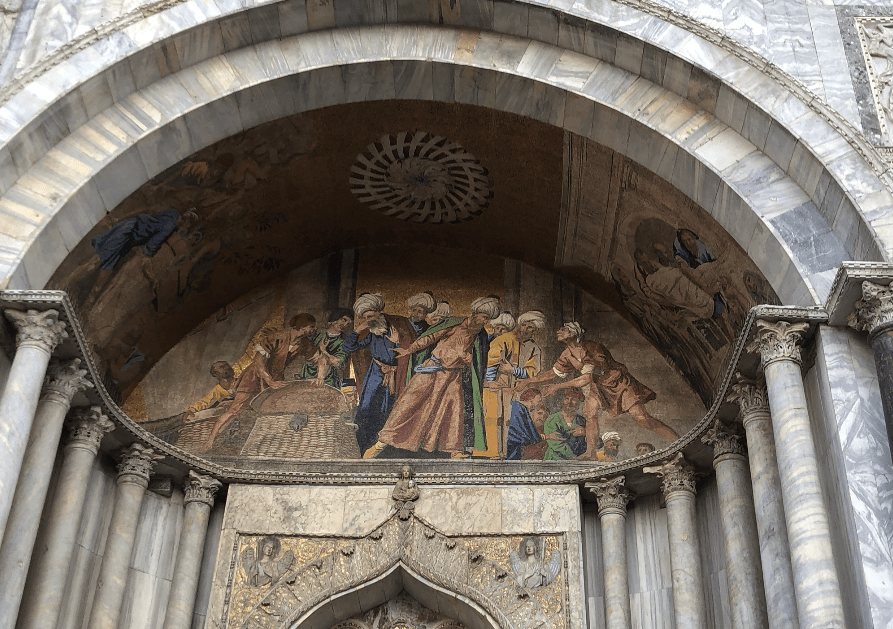
The Basilica di San Marco is an amazing building near the southern shore of Venice, Italy. I was astonished by the building which is covered with paintings and mosaics on both the interior and exterior. I was most interested in a mural on the exterior that depicts how the Venetians acquired the bones of St. Mark. I was impressed by the mural’s ability to explain the story so well.
With some extra research from the Basilica di San Marco’s website, I read the full story and could compare that to the photo I took of the mural. The mural depicts a specific part of the acquisition, the theft. Two Venetian merchants went to worship St. Mark’s relics and bring them to Venice. The men who guarded the relics were Muslim. The merchants developed an ingenious plan which relied on the fact that Muslims are forbidden from eating pork. The Venetians took the body of St. Mark and submerged the bones in baskets of pork fat and replaced his body with a nearby set of relics. The Muslim guards searched the merchants but refused to investigate the baskets of pork fat. The Venetians returned home and the city soon erected the Basilica di San Marco.
In the photo you can see that some men are wearing turbans and some are not. The men wearing turbans are the Muslims and the others are Venetians. A group of Muslims are in the center of the work with Venetians on both sides. On the right a Venetian can be seen with his arms slightly extended and his palms open. He appears to be offering an explanation to the Muslims who are leaning in to listen. On the left you can see a Venetian revealing a basket of pork fat as the Muslims cover their mouths and turn away in disgust. I love this mural because it depicts such an interesting story so accurately, this mural brought the story to life.
Portrait of the Four Tetrarchs outside the Basilica di San Marco
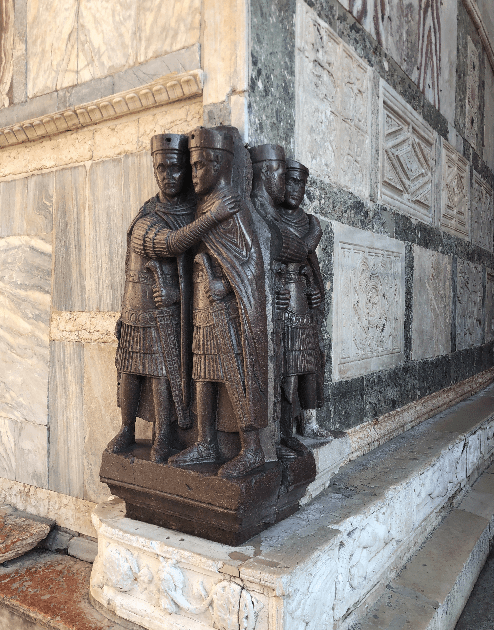
Outside of the Basilica di San Marco is the “Portrait of the Four Tetrarchs.” My attention was first drawn to the statue they seemed out of place. The statue is placed in a corner and the color contrasts with the rest of the building. I researched further because my tour guide joked that they were Roman leaders scared of the Venetians, but my research led me to a different conclusion.
Historians believe that the statue comes from the ancient city of Constantinople. The portrait depicts the four leaders of the Roman Empire and was originally supposed to represent solidarity and leadership. The four leaders of the empire holding each other, with weapons clearly visible. The statue was most likely brought back to Venice in the early 1200s during the fourth crusade. The four all appear very similar with small variations, for example, two of the four are bearded.
After I completed my research I was still very curious as to why the Venetians would attach this portrait to such an important structure. It could have been to symbolize their success in the fourth crusade and the sack on Constantinople. This reason makes sense to me because it’s a can create a spark of interest. Many people may see the seemingly out of place statue and research its meaning. Then, through their research, they would discover an important part of the city’s history, just as I did.
 Grand Tour — Winter 2020