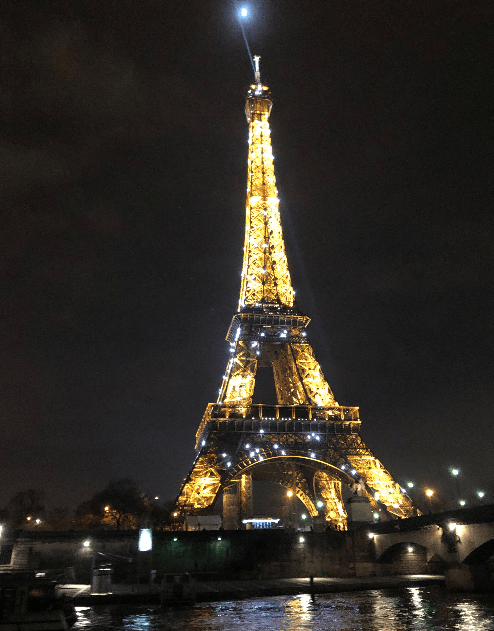
“Starry Night Over the Rhone” – Vincent Van Gogh —Musée d’Orsay
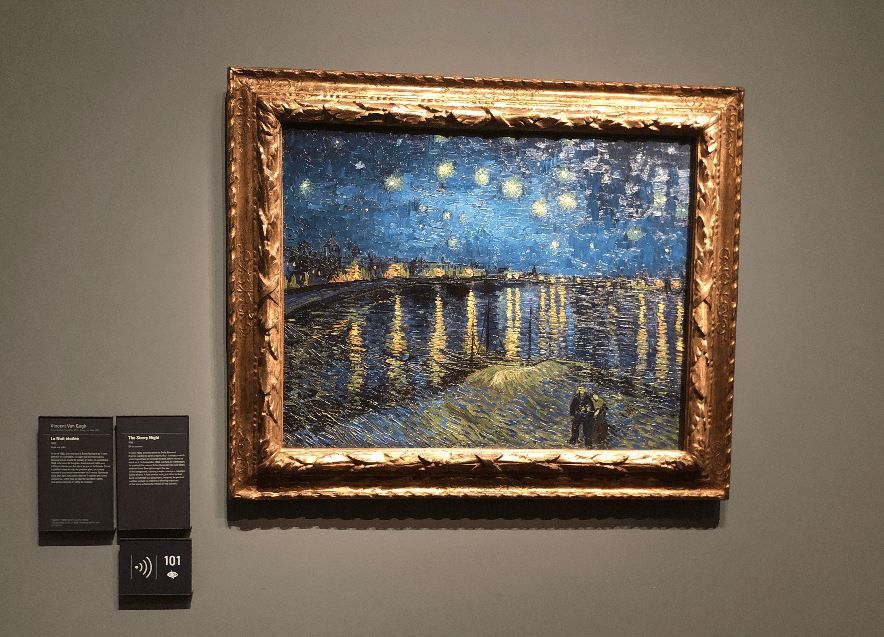
At the Musee d’Orsay I saw the Vincent Van Gogh painting “Starry Night Over Rhone.” Seeing this painting in person was amazing, and I really focused most of my time on a specific section of the painting. My eyes were glued to the water and its reflection of light. Van Gogh’s thick brush strokes and use of the impasto technique added an extra element of movement to the work that I have never seen done, as effectively, before.
The impasto technique adds a texture to the canvas, which allows the thick brush strokes and the variety of dark blues he used makes the painting come to life. The thick brush strokes over the impasto canvas appear to be small waves, flowing into shore and each other. The variety of dark blues add to the movement in a very important way. The small variations in the shades of blue appear to be the natural light from the sky reflecting off the water. This adds movement as well because it helps differentiate each brush stroke as a different wave.
The bright oranges and yellows that show the reflection of the lights from the houses on shore contrast with the dark blues of the water and highlight movement of the waves. The bright colored brushstrokes differ in horizontal length, but can still be traced back to their origin point. These bright brush strokes are occasional overlapped with just the slightest dark blues. This brings the movement to the lights. The combination of the different horizontal lengths and splashes of blue portray to lights and glimmering in the distance. This is where my eyes were drawn and where they stayed.
“Bedroom in Arles” —Vincent Van Gogh — Musée d’Orsay
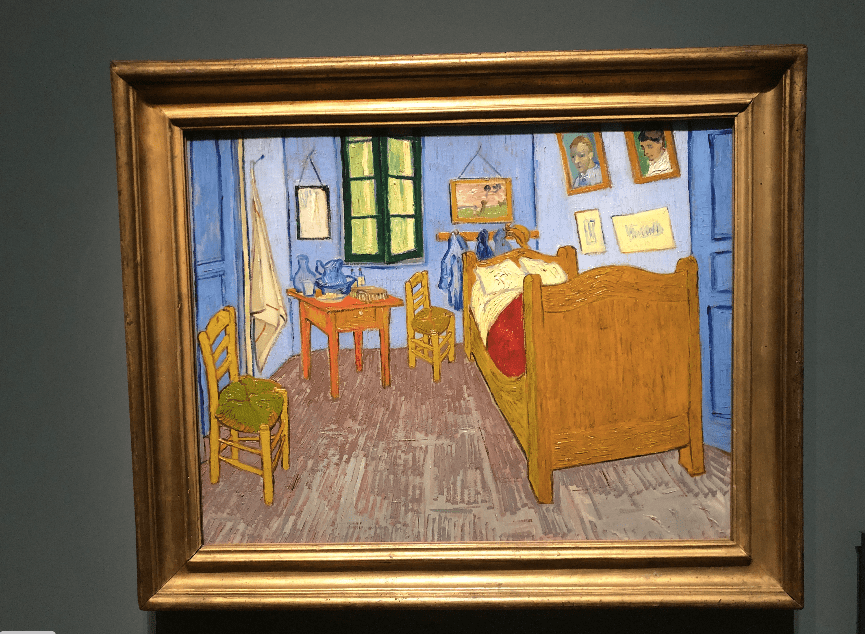
“Bedroom in Arles” by Vincent van Gogh is displayed in the Musee d’Orsay. I was particularly interested in the painting because of a letter I read in E.H Gombrich’s, The Story of Art. The letter is from Van Gogh to his brother that emphasizes his focus on the colors of the painting. It was important to read this letter because it explains Van Gogh’s intentions.
The painting seems to be overly simple and calm. This contrasts with many of the other Van Gogh paintings, which often have an omnipresent element of movement to them. Conversely, “Bedroom in Arles” has elements of tranquility and peace. Van Gogh said in his letter “…to look at the picture ought to rest the brain or rather the imagination.” This shows that Van Gogh’s motive was to create a painting that rested the brain rather than stimulate the brain.
This painting has a lot of Van Gogh signatures such as the distinct brush strokes and the use of color to convey emotion. Van Gogh uses a variety of blues as he paints the doors, walls, cloths on the wall and the water vase. This painting does lack the movement very common in Van Gogh artworks, but still fits into his oeuvre in a complimentary fashion.
 Grand Tour — Winter 2020